
Many small and medium businesses do marketing without a plan. They post when there is time, boost a post when sales are slow, and try a new channel when a competitor seems to be doing well on it. The result is effort that does not add up.
A marketing plan for a small business does not need to be a 50-page document. It needs to answer a few clear questions and connect every activity to a business goal. Here is a simple structure you can fill in this week.
1. Start with one business goal
Choose the outcome that matters most for the next three to six months. For example:
- Increase qualified leads for a service business.
- Grow online orders for a store.
- Fill appointments at a clinic or school.
- Launch in a new city or country.
Then turn it into a number you can track: “40 qualified leads per month” is a goal; “more awareness” is not. If you do not know your current numbers, the first step of the plan is to start measuring them.
2. Know your numbers
Three numbers make every other decision easier:
- Average customer value — how much a typical customer spends, and ideally how much over time.
- Conversion rate from lead to customer — out of every 10 leads, how many buy.
- Affordable cost per customer — how much you can spend to win a customer and still make a profit.
With these, you can work backwards: how many leads you need, and how much you can afford to pay for each one.
3. Define who you are selling to
“Everyone” is not a target audience. Describe two or three customer segments in plain words: who they are, what problem they want solved, what makes them hesitate, and where they look for solutions. For a clinic, one segment might be busy professionals who want fast booking; another might be families who care about trust and reviews. Different segments need different messages.
4. Sharpen the offer
Marketing amplifies whatever you offer. If the offer is unclear, more marketing only spreads confusion faster. Check that you can answer in one sentence: what do you offer, for whom, and why should they choose you over the alternatives? Then decide on an easy first step — a free consultation, a trial, a starter package, a clear price list.
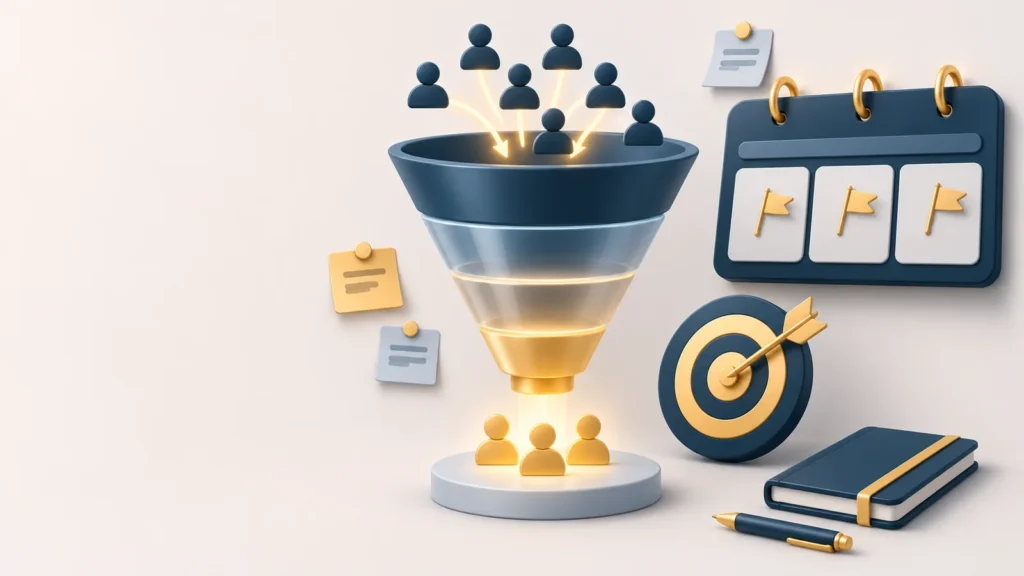
5. Map a simple funnel
A funnel is just the path a stranger takes to become a customer. Keep it to four stages:
- Attract — people discover you: ads, search, social media, referrals.
- Convince — they check you out: website, reviews, content, case studies.
- Convert — they take the first step: form, WhatsApp message, call, order.
- Keep — they buy again and recommend you: follow-up, offers, service quality.
For each stage, write down what you already have and what is missing. Often the biggest gain is not more traffic but fixing a weak stage — a slow website, no reviews, or leads that wait a day for a reply.
6. Choose a few channels and do them well
Small teams lose when they try to be everywhere. Pick channels based on where your customers are and how they buy:
- Meta ads (Facebook and Instagram) — strong for reaching local consumers and generating leads or messages quickly.
- Google search ads and SEO — strong when people actively search for what you sell.
- Social media content — builds trust and keeps you visible between purchases.
- WhatsApp and email — useful for follow-up and repeat sales with existing customers.
- LinkedIn — relevant mainly for B2B services.
Two or three channels done properly beat six done halfway.
7. Set the budget
Split the budget into three parts: production (design, video, content), media (ad spend) and tools or support. Start with a test budget for each paid channel, judge it against your affordable cost per customer, then move money toward what works. Keep a small share for testing new ideas.
8. Build a 90-day action plan
- Month 1 — Set up: tracking, website or landing page fixes, offer, first content and campaigns.
- Month 2 — Test: several messages, creatives and audiences; fix the weakest funnel stage.
- Month 3 — Scale: put more budget behind what works, stop what does not, plan the next quarter.
Assign an owner and a deadline to each task. A plan without owners is a wish list.
9. Review the right numbers every month
Keep the monthly review short and focused:
- Leads or orders, and cost per lead or per order, by channel.
- Lead-to-customer conversion rate.
- Revenue from marketing-sourced customers.
- What changed, why, and what you will do next month.
Reach, likes and followers can support the story, but they should not lead it.
A one-page plan template
- Goal for the next 90 days (one number).
- Key numbers: customer value, conversion rate, affordable cost per customer.
- Two or three customer segments and the main message for each.
- The offer and the first step.
- Funnel: what exists and what is missing at each stage.
- Two or three channels and the budget for each.
- 90-day tasks with owners and deadlines.
- Monthly review metrics.
Frequently asked questions
How much should a small business spend on marketing?
There is no universal percentage. Start from your affordable cost per customer and the number of customers you need, then test and adjust based on results.
Should I start with ads or social media content?
If you need results quickly and have a clear offer, ads usually move faster. Content builds trust over time. Most businesses benefit from both, in proportions that fit their goal and budget.
How often should the plan be updated?
Review the numbers monthly and update the plan every quarter, or sooner if your market or offer changes.
Building a plan tied to revenue is where our marketing strategy and growth service starts. Want help with yours? Book a free growth diagnostic.